
Plastic waste is one of the world’s biggest environmental challenges. As global industries move toward sustainability and circular economy models, understanding how plastic waste is collected, inspected, recycled, and transformed into new products is more important than ever.
At ASR-PSIC, we play a critical role in ensuring that recyclable plastics and scrap materials meet the required standards through accurate inspection and certification. This ensures safe, compliant, and high-quality recycling processes.
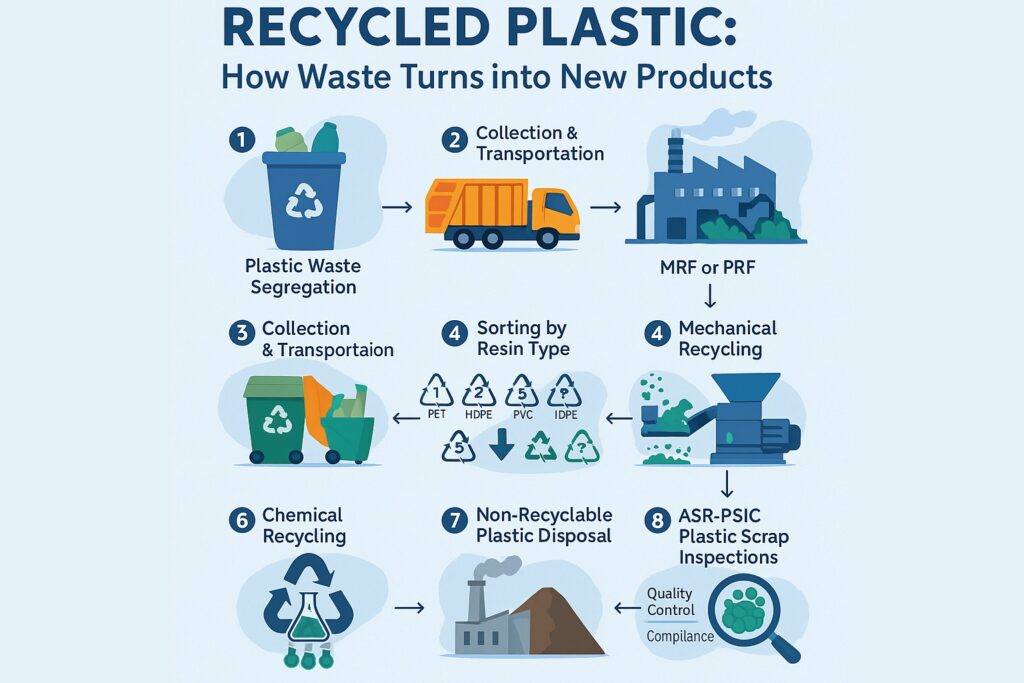
Below is a simplified, clear overview of how plastic waste moves through the recycling chain.
🟦 1. How Does the Plastic Recycling Process Begin?
The recycling journey starts when plastic waste is properly segregated at source. Clean and correctly sorted plastic ensures:
- Higher recovery value
- Fewer contaminants
- Better recycling efficiency
Consumers, industries, and waste management facilities all contribute to this first step.
🟧 2. Collection & Transportation: From Bins to Recovery Facilities
Once collected, plastic waste is sent to:
- MRFs (Material Recovery Facilities)
- PRFs (Plastic Recovery Facilities)
Here, the inspection, sorting, and quality evaluation process begins. Operators use:
- Conveyor sorting systems
- Optical scanners
- Air jets
- Manual inspection
This stage ensures that only recyclable materials move ahead.
🟩 3. Sorting Plastics by Resin Type
Plastics are identified using the resin code symbols (1–7). Common recyclable grades include:
- PET (1): Bottles, packaging
- HDPE (2): Containers, drums
- PVC (3): Pipes, fittings
- LDPE (4): Bags, films
- PP (5): Caps, buckets, crates
Correct resin identification is essential because each plastic type has a different melting point and recycling method.
🟦 4. Mechanical Recycling: The Most Common Method
Mechanical recycling includes:
🔹 Shredding
Plastic is chopped into flakes.
🔹 Washing & Decontamination
Removes dirt, labels, adhesives, and food residues.
🔹 Density Separation
Using float-sink tanks and air classifiers.
🔹 Drying
🔹 Melting & Extrusion
Flakes are melted and converted into pellets, which act as raw material for manufacturing new products.
Many industrial products made from mechanically recycled plastic include:
- Crates
- Packaging
- Pipes
- Plastic lumber
- Household items
🟥 5. Challenges in Plastic Recycling
Despite advancements, the sector faces several obstacles:
⚠️ Contamination
Dirty, oily, food-soiled plastic reduces recyclability.
⚠️ Composite Materials
Multi-layer packaging is difficult to process.
⚠️ Economic Viability
When crude oil prices drop, virgin plastic becomes cheaper than recycled plastic.
⚠️ Limited Demand
Some industries prefer virgin resin due to consistency.
These issues highlight the importance of strict inspections, proper sorting, and reliable certification—services provided by organizations like ASR-PSIC.
🟫 6. Chemical Recycling: The New Technology
Chemical recycling breaks plastic down into its basic chemical components. It can process:
- Mixed plastic
- Contaminated plastic
- Multi-layer packaging
While not yet widely used due to cost and energy consumption, it is expected to play a major role in the future recycling landscape.
🟪 7. What Happens to Non-Recyclable Plastic?
Non-recyclable plastic often ends up in:
- Waste-to-energy plants
- Secure landfills
- Co-processing
- Export facilities (subject to strict compliance and documentation)
Reducing single-use plastic and improving product design are key to minimizing unrecyclable waste.
🟦 8. How ASR-PSIC Supports Plastic Recycling
At ASR-PSIC, we assist industries in the recycling sector through:
✔ Pre-Shipment Inspections (PSIC)
✔ Quality verification of plastic scrap
✔ Compliance checks
✔ Container loading inspections
✔ Radioactivity, contamination, and documentation checks
✔ Ensuring materials meet import/export standards
Whether you deal in:
- PET bottles
- HDPE drums
- Mixed plastic scrap
- Industrial packaging
- Plastic regrind / pellets
We ensure your material meets the quality and compliance requirements of global markets.
🟩 9. Building a Circular Economy for Plastics
The future of plastic recycling depends on:
- Better segregation
- Advanced recycling technologies
- Stronger compliance
- Quality inspections
- Collaboration between industries
Through reliable inspection and certification, ASR-PSIC helps companies maintain quality, follow regulations, avoid penalties, and contribute to sustainable recycling practices.
📌 Conclusion
The journey from plastic waste to new products involves multiple steps—from sorting to processing to strict inspection. With proper systems in place, recycled plastic can re-enter the supply chain safely, reducing environmental impact and supporting the circular economy.
ASR-PSIC is committed to supporting this mission with trusted inspection and certification services.